
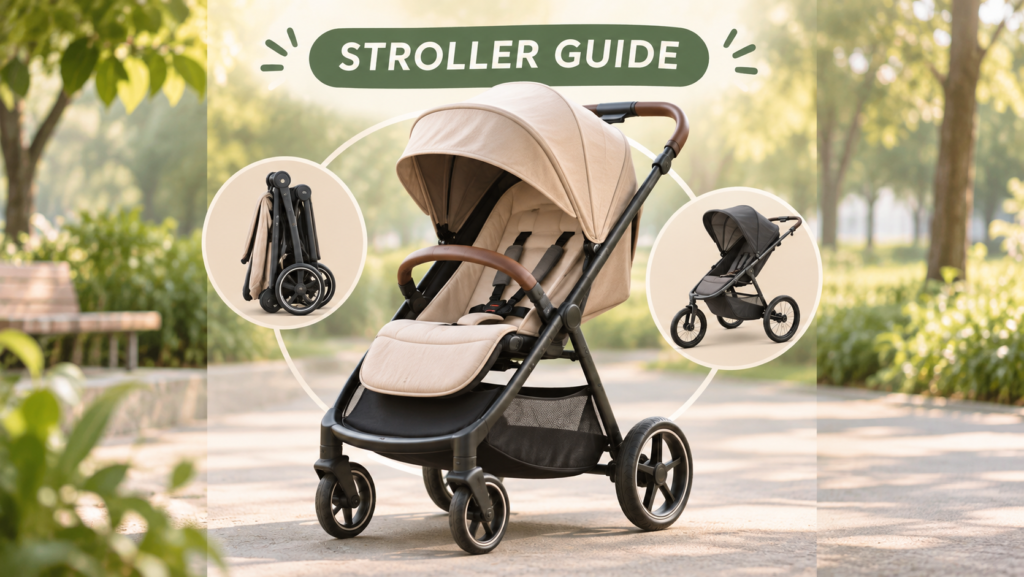
How to Choose a Stroller: Types, Features and What Actually Matters
Disclosure: DailyPick Journal may earn a commission if you book or buy through a link on this page, at no extra cost to you. Prices below were checked on November 10, 2026 (USD).
Most parents buy the wrong stroller for the same reason: they shop by brand and showroom feel, then discover at home that it doesn’t fit the car trunk, won’t fold one-handed while holding a baby, or rattles to pieces on their actual sidewalks. A stroller is a piece of equipment you’ll push nearly every day for three to four years, so the right choice comes from your routine, not from a “best stroller” list.
This guide walks through the decision the way a good baby-gear specialist would: start with how you live, pick the stroller type that fits, then check the handful of features that make a real difference. We also cover the safety standard to look for and a situation many families overlook — traveling — where renting often beats buying a second stroller.
Start with these five questions
Answer these honestly before you look at a single product page. Each one rules out whole categories.
1. Do you mostly drive, walk, or use public transport?
If you drive almost everywhere, folded size and weight matter more than suspension, because you’ll lift the stroller into a trunk several times a day. If you walk a lot, prioritize bigger wheels, a large basket and a comfortable handlebar. If you rely on buses, trains or stairs, a compact stroller you can fold with one hand and carry is worth more than any premium feature.
2. How much space do you have at home and in the car?
Measure your trunk opening and the floor depth, plus the spot by the door where the stroller will live. Folded dimensions are listed on every manufacturer spec sheet; compare them against your tape measure, not against your memory of the showroom.
3. Do you need a car seat to click in during the newborn months?
Newborns can’t sit upright and need either a near-flat seat, a bassinet attachment, or an infant car seat that clicks onto the frame. A car-seat-compatible stroller lets you move a sleeping baby from car to stroller without unbuckling. Note that the American Academy of Pediatrics advises against letting infants routinely sleep in sitting devices like car seats and strollers, so transfer baby to a flat, firm sleep surface for longer naps.
4. Are you planning another child soon?
If the age gap will be under about two to three years, a “single-to-double” convertible stroller can save you from buying twice. If not, buy the best single for your needs now.
5. Do you run, hike, or walk on rough terrain?
Gravel paths, grass and broken pavement call for air-filled or larger rubber tires and real suspension. Running with a stroller requires a true jogging stroller with a fixed or lockable front wheel and a wrist strap — not an all-terrain stroller with a swivel wheel.
Stroller types compared
Once you’ve answered the questions above, one or two of these types will stand out.
| Type | Best for | Strengths | Watch out for |
|---|---|---|---|
| Full-size | Everyday walking, suburban life | Big basket, comfortable seat, good suspension, often car-seat compatible | Weight and folded size; can be awkward on transit |
| Travel system | First-time parents with a newborn who drive | Stroller + infant car seat sold as a matched set; click-in convenience | Bulk; the infant car seat is typically outgrown within the first year or so |
| Lightweight / compact | City living, public transport, flights | Easy to carry and store; some fold small enough for overhead bins | Smaller baskets, less suspension, often not suitable from birth without an add-on |
| Umbrella | Occasional use, toddlers, backup stroller | Cheapest, very light, slim fold | Minimal recline and canopy; not for newborns |
| Jogging | Runners, trails, uneven ground | Large air tires, suspension, lockable front wheel, hand brake | Large footprint; most makers say not for running until roughly 6–8 months — check your manual |
| Double (side-by-side) | Twins, siblings close in age | Both kids get an equal view; pushes evenly | Width through doorways, store aisles and crowds |
| Double (tandem) / convertible | Growing families, narrow spaces | Single-stroller width; converts as the family grows | Long and heavier to steer; rear seat has a limited view |
A quick decision tree
If you want a shortcut, this is the logic we use when friends ask which type to buy.
The features that actually matter
Spec sheets list dozens of features. In daily use, these are the ones parents notice — for better or worse.
The fold
Try the fold in the store (or watch an unedited video) while imagining a baby on your hip. A true one-hand fold, a stroller that stands on its own when folded, and a carry handle make a bigger difference to daily life than almost any comfort feature. Check whether you have to remove the seat or canopy to fold it — some modular strollers require it.
Weight vs. stability
Lighter is easier to lift, but very light frames can feel twitchy on rough ground and tip more easily when you hang bags on the handlebar. As a reference point, the Baby Jogger City Mini single — a popular compact model — is listed at 17 lb, while a City Mini double is 28 lb. If you’ll lift the stroller into a car several times a day, every extra pound counts.
Wheels and suspension
Small plastic wheels are fine on mall floors and smooth sidewalks. Larger rubber or foam-filled wheels handle cracks and curbs far better, and air-filled tires give the smoothest ride on grass and gravel — at the cost of occasional flats. All-wheel suspension matters if your sidewalks are poor or your baby naps on walks.
Seat recline and newborn suitability
For a baby under about six months, look for a seat that reclines nearly flat, a bassinet option, or car seat compatibility. A seat that faces you (parent-facing) is a nice bonus for the first months; a seat that can switch to world-facing keeps toddlers happy later.
Canopy
A large canopy with a sun-protection rating and a peek-a-boo window is one of the most underrated features. Small umbrella-stroller canopies barely shade the legs; if you live somewhere sunny, this alone can decide between two models.
Basket
Look at how easy the basket is to reach when the seat is reclined, not just its listed capacity. A big basket you can’t get a diaper bag into is a small basket.
Handlebar and brake
An adjustable or telescoping handlebar helps when parents are different heights. A foot brake you can operate in flip-flops — and that doesn’t scrape your shins — matters more than you’d think.
Weight and height limits
Check the maximum child weight and height. Many single strollers top out around 50 lb; for example, Baby Jogger lists the City Mini single as best for kids up to 44″ tall and 50 lb. If you expect to use a stroller for an older toddler at theme parks or on long trips, these limits matter.
Safety: what to check before you buy
In the United States, strollers and carriages must meet a mandatory federal safety standard (16 CFR part 1227) enforced by the U.S. Consumer Product Safety Commission, which incorporates the voluntary standard ASTM F833. It covers hazards such as brake performance, stability, restraint systems, hinge pinch points and entrapment openings. Any stroller sold new by a reputable U.S. retailer should comply — be more careful with unknown marketplace sellers and very old secondhand strollers.
- Use a five-point harness from day one and adjust it as your child grows.
- Check recalls on CPSC.gov before buying used, and register your stroller with the manufacturer so you’re notified of future recalls.
- Don’t overload the handlebar. Heavy bags hung on the handle are a common cause of tip-overs when the child climbs out.
- Lock the brake every time you stop, even on surfaces that look flat.
- Keep fingers clear when folding and make sure the stroller is fully latched open before putting a child in.
- Running: use only a dedicated jogging stroller, lock the front wheel, wear the wrist strap, and follow the manufacturer’s minimum age. Ask your pediatrician if you’re unsure your baby has enough head and neck control.
Budget: where spending more helps (and where it doesn’t)
Price tracks build quality, suspension, fabrics and fold design more than safety — every compliant stroller meets the same federal standard. Spending more tends to buy you a smoother push, a better fold, more durable wheels and better resale value. It doesn’t buy you a “safer” baby.
A practical approach: put most of your budget into the stroller you’ll use every day, and don’t buy a second stroller for occasional situations unless you’ll really use it. A cheap umbrella stroller is a reasonable backup; a second premium stroller usually isn’t.
The situation most buying guides skip: travel
Your everyday stroller may be exactly wrong for a vacation. A heavy full-size model is a pain to gate-check and haul through airports, a jogging stroller may be too wide for crowded attractions, and theme parks have their own rules. Walt Disney World, for example, does not permit strollers larger than 31″ (79 cm) wide or 52″ (132 cm) long, and it bans stroller wagons entirely.
For a theme park trip, families usually have three options: bring their own stroller, rent inside the park, or rent from an off-site company that delivers to the hotel. Here’s how the numbers looked for a 7-day Orlando trip when we checked prices on November 10, 2026:
| Option | Cost | Pros | Cons |
|---|---|---|---|
| Bring your own | Free to use; airline gate-check policies vary | Your child already knows it; usable at the airport | Risk of airline damage; must meet park size limits; extra luggage |
| Disney in-park rental | $15/day single, $31/day double; $13 and $27/day length-of-stay | Nothing to book ahead; replacement if lost (with receipt) | Basic hard-seat strollers; must stay inside the park, so no use at the hotel or on the bus/monorail ride |
| Off-site rental (e.g. Kingdom Strollers) | From $60 single / $80 double for 1–3 nights | Branded strollers (Baby Jogger, BOB), free delivery and pickup at your hotel, use it all day everywhere | Must book ahead; you’re responsible for it outside the parks |
A closer look at Kingdom Strollers
Kingdom Strollers is an Orlando rental company that delivers strollers to resorts, hotels and vacation homes in the area, with free delivery and pickup, plus delivery and drop-off at Orlando International Airport. Its fleet, as listed on its site on November 10, 2026, includes:
- Singles: Baby Jogger City Mini, City Mini GT, Summit X3 and BOB Revolution.
- Doubles: City Mini Double, City Mini GT Double and BOB Revolution Duallie.
- Other rentals: special-needs strollers, mobility scooters, and cribs and bedding.
Rentals run up to a maximum of 21 days, and pricing is by rental length rather than per day. For the City Mini models we checked:
| Rental length | City Mini Single | City Mini Double |
|---|---|---|
| 1–3 nights | $60 | $80 |
| 4–7 nights | $80 | $100 |
| 8–10 nights | $100 | $120 |
| 11–14 nights | $120 | $140 |
| 15–18 nights | $140 | $160 |
| 19–21 nights | $160 | $180 |
Prices in USD from kingdomstrollers.com, checked November 10, 2026. Other models may be priced differently.
Both City Mini models come with a free drink holder/parent console, rain cover and cooler bag, and both are listed as meeting Disney’s size requirements (24″W × 37″L for the single, 30″W × 37″L for the double). A snack tray and stroller hooks are offered as add-ons with limited availability.
The trade-off is planning: you need to reserve dates ahead, and the stroller is your responsibility for the whole trip, including when you park it outside a ride. On review sites the company has a large volume of feedback — Trustpilot listed more than 6,800 reviews at the time of writing — so read recent reviews for your travel season before booking, especially comments about delivery timing.
When renting beats buying a travel stroller
If your only reason to buy a second, compact stroller is one or two vacations, renting is usually cheaper and spares you the airline gate-check. If you fly several times a year, a good compact travel stroller you own will pay for itself. And if your everyday stroller is a jogger or a wide side-by-side double, check it against the park’s size rules before you pack it.
How to test a stroller before committing
- Fold it five times in a row. If it’s annoying in the store, it’ll be infuriating in a parking lot.
- Lift it to trunk height. Do this with the weight you’ll carry daily, not with a salesperson helping.
- Push it one-handed. You’ll often have a coffee, phone or toddler in the other hand.
- Try a curb. Tip the front wheels up with your foot on the rear axle; good strollers make this easy.
- Check the basket with the seat reclined.
- Look up the return policy and keep the box until you’ve used it for a week.
How to save on your next stroller rental
If you’re heading to Orlando with little ones, booking a stroller that’s waiting at your hotel means you skip the in-park rental line, get a branded, padded stroller instead of a basic hard-seat one, and can use it from the hotel room to the bus stop and back. Pick your delivery and return dates first — pricing is based on the number of nights — and choose a model that fits your kids’ ages and Disney’s size limits.
Check Kingdom Strollers availability & prices
For everyday life at home, go back to the five questions at the top: the right stroller is the one that fits your car, your sidewalks and your routine — not the one with the longest feature list.
Sources: U.S. Consumer Product Safety Commission, “Carriages and Strollers” business guidance (cpsc.gov); ASTM F833 Standard Consumer Safety Performance Specification for Carriages and Strollers; Walt Disney World, “Rules for Using Strollers” FAQ and “Stroller Rentals” guest services page (disneyworld.disney.go.com), checked Nov 10, 2026; Kingdom Strollers product and pricing pages (kingdomstrollers.com), checked Nov 10, 2026; Trustpilot, Kingdom Strollers reviews page; American Academy of Pediatrics safe sleep guidance (healthychildren.org).