
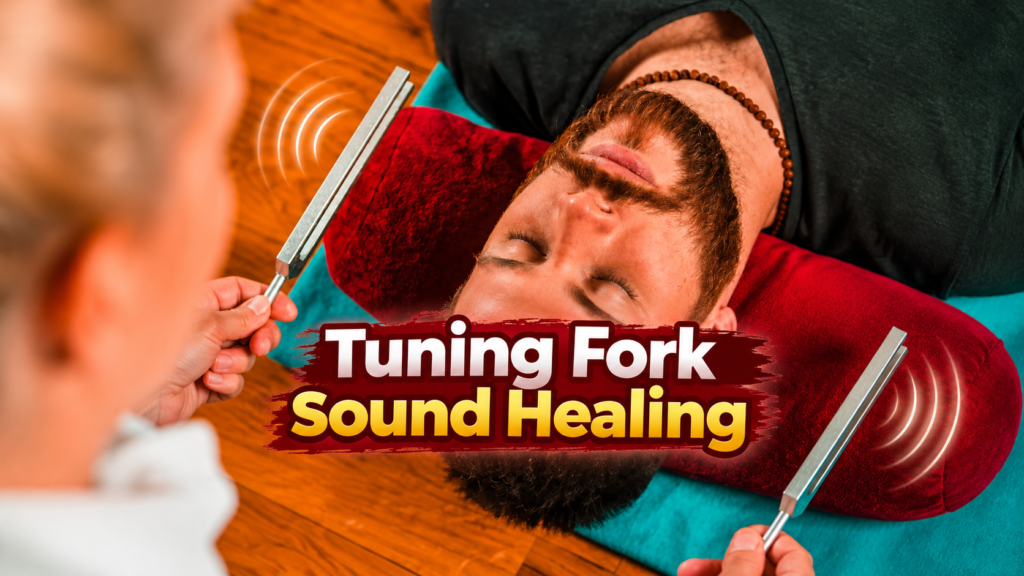
Tuning Fork Sound Healing: A Practical, Honest Guide for Beginners
Disclosure: This article contains one affiliate link and a discount code. If you order through them, DailyPick Journal may earn a commission at no extra cost to you. Prices were last checked on purefrequencies.com (US store, USD) on 17 November 2026. This is general information, not medical advice.
The short version
Tuning fork sound healing uses precisely tuned metal forks in two ways: placed on the body so you feel the vibration, or held near the ears so you hear a clean, fading tone. Research on forks specifically is thin, but sound-based relaxation has encouraging early evidence, and the practice is simple and low-risk. This guide covers how it works, which frequencies matter, a 10-minute routine and how to choose a first set. If you decide to buy, code THANKYOU takes 10% off Pure Frequencies sets.
You have probably seen tuning forks on social media: someone strikes a silver fork, rests it on a shoulder, and the caption promises everything from better sleep to “cellular repair”. It is hard to tell what is real. This guide strips the topic back to what a beginner needs: what the forks actually do, what the evidence supports, how to use them safely at home, and what to look for if you decide to buy a set.
What is tuning fork sound healing?
A tuning fork is a two-pronged metal instrument that vibrates at one fixed frequency when struck. Musicians use them for pitch. Doctors still use them in clinics: a 128 Hz fork checks vibration sense in the feet, and a 512 Hz fork is used in classic bedside hearing tests. Sound healing borrows the same tool for a different goal: relaxation and body awareness.
A typical session involves striking a fork and then either:
- Placing its stem on the body, such as a tight shoulder, the sternum, or a bony point like the knee or ankle, so you feel the vibration travel through tissue; or
- Holding it a few inches from each ear, so you hear a clean, sustained tone that gives the mind something simple to focus on.
Much of the modern practice traces back to practitioners such as Dr. John Beaulieu, whose work popularized tuning fork protocols in the late 20th century. One reason forks caught on is durability: a well-made fork holds its frequency for years, unlike many electronic gadgets.
Tuning fork work is closely related to a sound bath, but more hands-on. A sound bath is mostly about lying still and listening; fork work adds touch and lets you target specific areas. If listening is what you are after, our guide on how to do a sound bath at home walks through a 20-minute routine.
How tuning fork therapy works
Tuning forks reach you through two channels: touch and hearing. Which one you prefer decides which forks you should start with.
Vibration through the body (weighted forks)
Weighted forks have round discs on the ends of the prongs. The weights slow the vibration and make it stronger and longer-lasting, so you feel more than you hear. Placed on a muscle or joint, the fork produces a gentle buzzing sensation, a little like a very light, very precise massage tool. Many people find this calming in the same way slow, rhythmic touch is calming.
Sound through the ears (unweighted forks)
Unweighted forks have plain prongs. They ring with a clearer, longer tone and are mostly used near the ears. Listening to a pure, fading tone works like a focus anchor in meditation: as the sound fades, your attention follows it into stillness. Two forks played together, one at each ear, create an interval that many people find pleasant and settling.
What tuning forks do not do is “retune” your cells or repair DNA, despite what some websites claim. The honest description is that they are a structured way to trigger the body’s relaxation response.
What does the research say?
| Claim | Evidence level | What we know |
|---|---|---|
| Sound meditation can reduce tension and improve mood | Early but encouraging | An observational study of 62 adults found drops in tension, anger, fatigue and depressed mood after singing bowl sound meditation (Goldsby et al., 2017). It had no control group and studied bowls, not forks. |
| Tuning forks are precise, reliable vibration sources | Established | Clinicians routinely use 128 Hz and 512 Hz forks for neurological and hearing exams. |
| Gentle vibration on muscles feels relaxing | Plausible, widely reported | Consistent with how people respond to massage and vibration tools. Fork-specific trials are limited. |
| Specific frequencies cure pain, anxiety or disease | Not established | No large, controlled human trials support treatment claims for any specific fork frequency. |
| 528 Hz “repairs DNA” | Unsupported | A popular internet claim with no credible evidence behind it. |
Weighted vs. unweighted tuning forks
| Feature | Weighted forks | Unweighted forks |
|---|---|---|
| Design | Discs on the prong tips | Plain prongs |
| Main sensation | Strong, felt vibration | Clear, ringing tone |
| How you use it | Stem placed on muscles, joints, bony points | Held 2–4 inches from the ears or around the body |
| Common goals | Physical tension, grounding, body awareness | Meditation, focus, calming a busy mind |
| Typical frequencies | 128 Hz, 136.1 Hz | 256 Hz, 384 Hz, 512 Hz and up |
| Best for | People who like massage-style relief | People who prefer listening and breathwork |
Most beginners benefit from having at least one of each. That way you can find out whether you respond more to touch or to sound before spending more.
The most common frequencies explained
You will see dozens of frequencies online. These show up most often in beginner sets, and each has a clear practical use:
| Frequency | Type | Where it comes from | How practitioners use it |
|---|---|---|---|
| 128 Hz | Weighted | A low C; the same pitch clinicians use for vibration testing | On tight muscles, joints and bony points for a strong, soothing buzz |
| 136.1 Hz | Weighted | The “Om” or Earth-year tone, from Hans Cousto’s “cosmic octave” | On the sternum or feet for grounding before meditation |
| 256 Hz | Unweighted | A C note, an octave above 128 Hz | Near the ears to start a listening meditation |
| 384 Hz | Unweighted | A G note; forms a perfect fifth (3:2) with 256 Hz | Played with 256 Hz, one at each ear, for a balanced interval |
| 528 Hz | Unweighted | Popular in the “solfeggio” frequency tradition | Listening meditation; often marketed with claims that lack evidence |
Two honest notes. First, the stories attached to frequencies, such as “Earth’s Om” or chakra links, are traditions, not physiology. Second, the 3:2 perfect fifth is real music theory: it is one of the most consonant intervals, which is one reason many people find it naturally calming.
How to use tuning forks at home: a 10-minute routine
This routine focuses on placement, so it works best with at least one weighted and two unweighted forks. Strike forks on a rubber activator puck, a mallet or your knee, never on a table or other hard surface, which can knock them out of tune.
- Settle in (1 minute). Sit or lie somewhere quiet. Take five slow breaths, making each exhale longer than the inhale.
- Ground with 136.1 Hz (2 minutes). Strike the weighted fork and place the stem on your sternum, then on the top of each foot, for 30–60 seconds each.
- Release tension with 128 Hz (3 minutes). Place the stem on a tight area: base of the skull, tops of the shoulders or the knees. Hold for 30–60 seconds, re-strike and move.
- Listen with 256 Hz and 384 Hz (3 minutes). Strike both unweighted forks and hold them 2–4 inches from your ears, one on each side. Breathe slowly and follow the tone as it fades. Repeat 3–5 times.
- Rest (1 minute). Sit quietly and notice how your body feels before getting up.
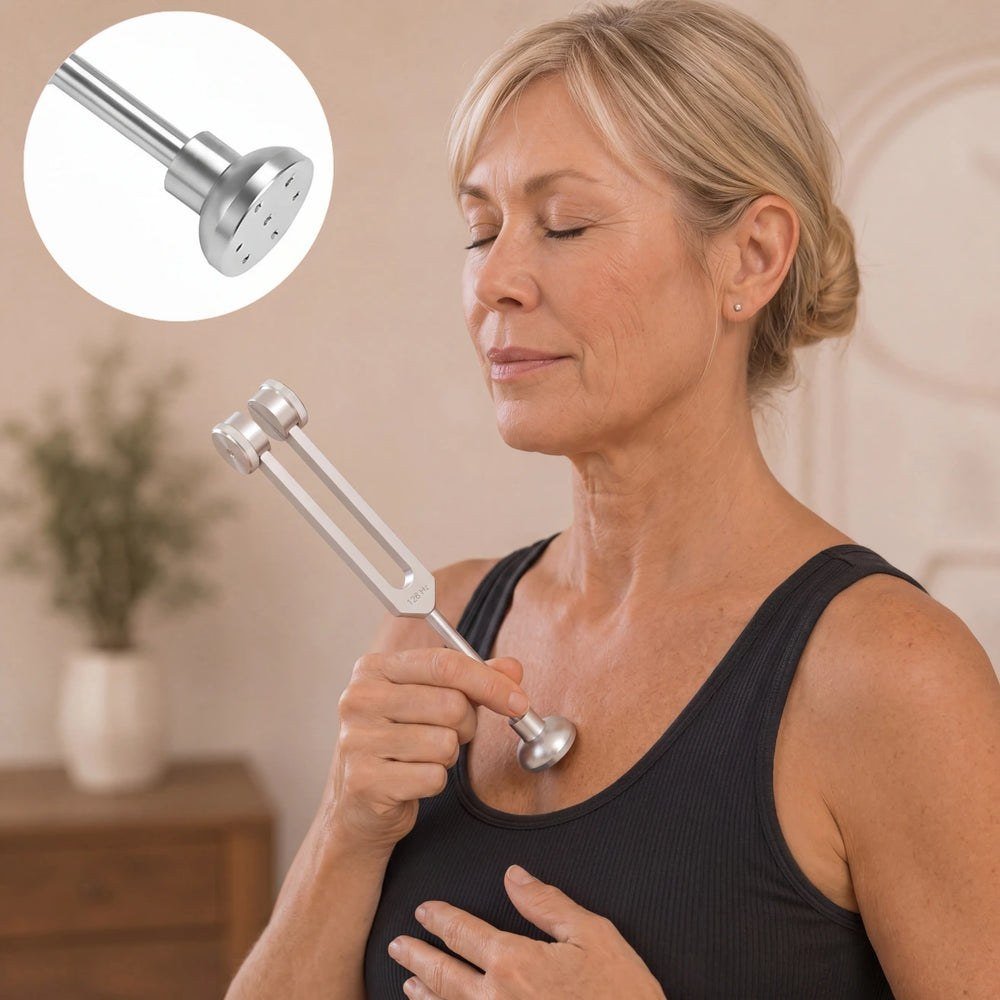
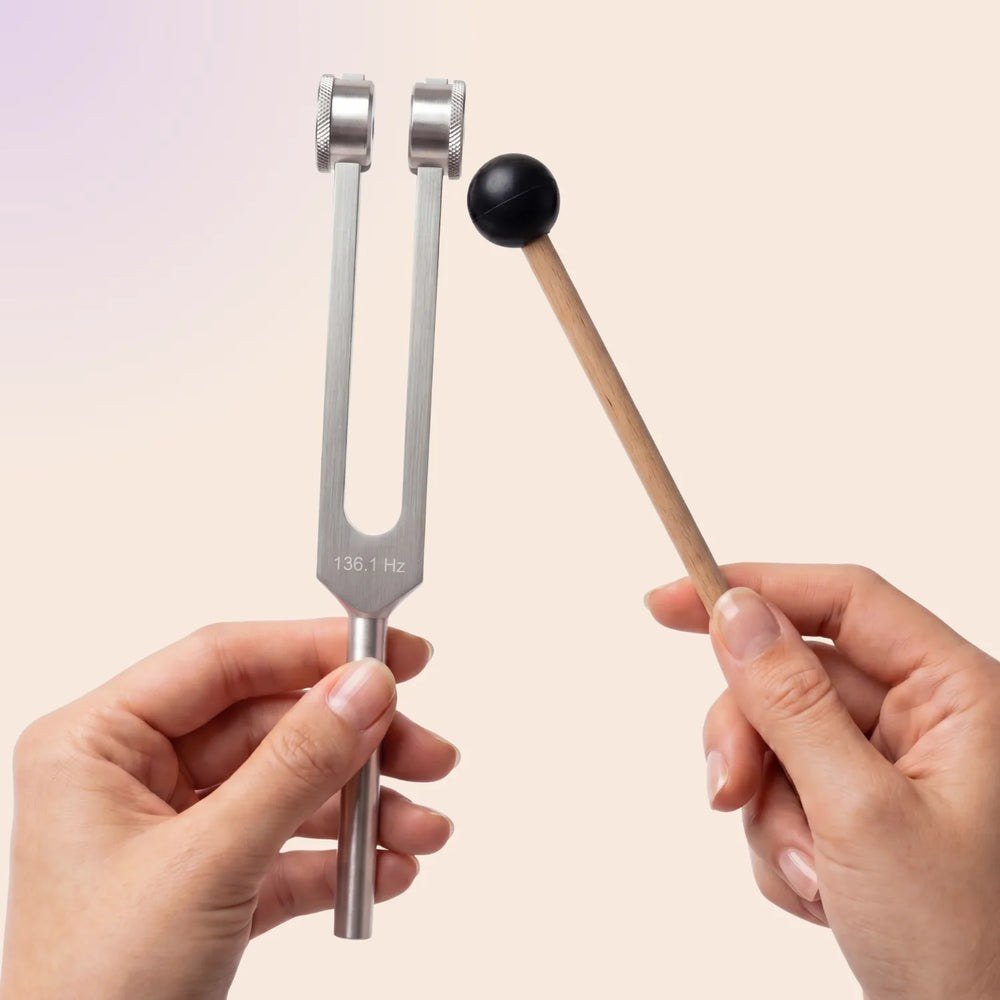
Product images: Pure Frequencies
Tips for better results
- Consistency beats intensity. Five to ten minutes daily tends to work better than one long session a week.
- Pair it with breath. Slow exhales amplify the calming effect.
- Use it before bed. The listening step fits naturally into a wind-down routine.
- Hold the stem, not the prongs. Touching the prongs stops the vibration.
- Keep a short note. Track sleep, tension and mood for two weeks to see what changes for you.
Safety: who should be careful
Tuning forks are low-risk for most people, but use common sense:
- Pacemakers and implants: don’t place forks directly over a pacemaker, insulin pump or other implanted device. Ask your doctor first.
- Recent surgery or injury: avoid fresh incisions, fractures, open wounds and acutely inflamed areas.
- Pregnancy: avoid placing weighted forks on the abdomen and ask your provider first.
- Hearing: keep forks a few inches from your ears; never touch the prongs to the ear.
- Medical conditions: forks are not a substitute for diagnosis or treatment of pain, anxiety, insomnia or any other condition.
Some people feel briefly lightheaded or emotional as they relax. Sit up slowly and drink water afterwards.
How to choose a tuning fork set
Cheap forks are everywhere, but quality matters more than with most wellness gadgets. A fork that is out of tune, or that stops ringing after a few seconds, defeats the purpose. Look for:
| What to check | Why it matters |
|---|---|
| Stated frequency accuracy | Reputable brands publish a tolerance, such as ±0.5%. If none is listed, you can’t know what you are hearing. |
| Material and finish | Machined aluminium forks ring longer and hold their tune better than thin cast forks. |
| Both fork types | A mix of weighted and unweighted forks lets you explore touch and sound. |
| An activator | A rubber mallet or puck gives a clean strike without damaging the fork. |
| Learning materials | A placement guide or short course shortens the learning curve. |
| Return policy | Results are personal, so a generous trial period lowers the risk. |
If you only want to hear what a fork sounds like, a single inexpensive fork is a fine experiment. If you want a set that covers the whole routine above, buy once and buy one with stated accuracy and a return window.
Our pick for beginners: Pure Frequencies Harmony Set
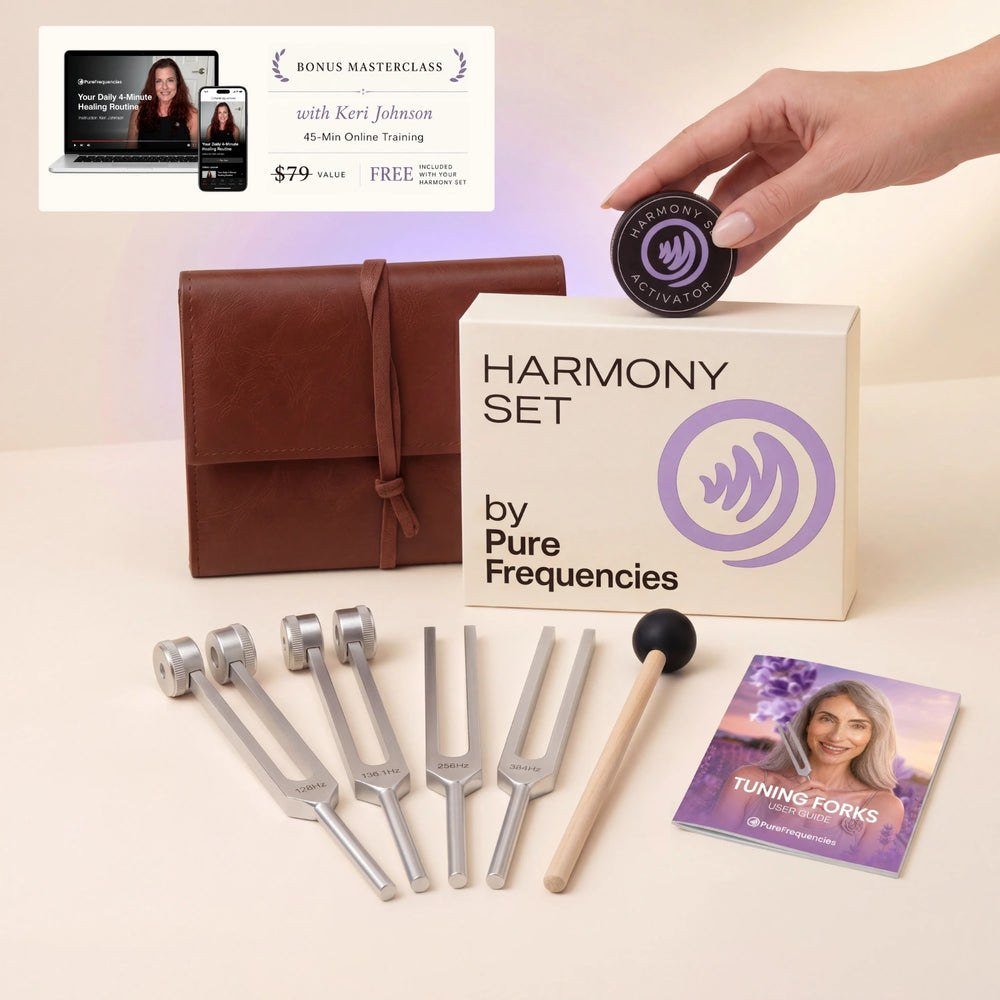
Covers every step of this guide
Harmony Tuning Fork Set (4 forks) · $109.95 (list $149.80)
Two weighted forks (128 and 136.1 Hz) and two unweighted forks (256 and 384 Hz), the exact four used in the routine above. With code THANKYOU it comes to about $98.95.
| Harmony Set details | |
|---|---|
| Forks | 128 Hz and 136.1 Hz (weighted); 256 Hz and 384 Hz (unweighted) |
| Build | Machined aluminium; the brand states ±0.5% frequency accuracy |
| In the box | Storage case, activator mallet and puck, printed guide; the store also promotes a bonus course with the set |
| Price (US) | $109.95, listed against $149.80; checked 17 November 2026 |
| Returns | 60 days, used items accepted; customer pays return shipping |
| Delivery | Processing up to 2 business days (up to 4 for standard), then about 4–10 business days to the US |
| Independent rating | Trustpilot 4.6 from 889 reviews (checked 30 October 2026) |
Why it is a good starting point: you get the four frequencies most beginner routines use, a proper activator and a guide in one box. The 60-day return window, which accepts used items, lets you find out whether fork work suits you before you commit.
What to keep in mind: Pure Frequencies’ marketing makes strong claims, such as nitric oxide release. Those claims rest on limited early research and are not established by large human trials. Reviewers also mention slow international delivery and small print in the booklet. Buy it as a relaxation tool and you are likely to be happy with it. Our full Pure Frequencies review covers build quality and complaints in detail.
If you prefer one focus over the other, the brand also sells smaller sets: the Grounded set (two weighted forks, $64.95) for body work, and the Serenity set (136.1, 256 and 528 Hz, $79.95) for listening.
How to get 10% off
Open the Pure Frequencies store through the button below, add the Harmony Set (or any set) to your cart, and enter THANKYOU at checkout. Confirm the discount appears before paying. If a sitewide sale is running, compare totals and keep whichever is lower. Shipping and any import duties depend on your country.
Get 10% off Pure Frequencies with THANKYOU
Individual results vary. Tuning forks are not intended to diagnose, treat, cure or prevent any disease. Consult a qualified healthcare provider for medical concerns.
Related reading
- HealFlux Frequency Device v4 Review: What It Does, What It Can’t & How to Save 10%
- IM8 Discount Code: BECKA10 for 10% Off IM8 Health (Tested November 2026)
- How to Do a Sound Bath at Home: A Simple 20-Minute Routine to Unwind
- Pure Frequencies Reviews: An Honest Look at the Harmony Set
Sources (checked 17 November 2026): Goldsby TL et al. “Effects of Singing Bowl Sound Meditation on Mood, Tension, and Well-being: An Observational Study.” Journal of Evidence-Based Complementary & Alternative Medicine, 2017; Pure Frequencies product pages (Harmony, Grounded and Serenity sets) and US prices; Pure Frequencies refund and shipping policies; Trustpilot profile for purefrequencies.com (checked 30 October 2026). Discount code provided through Pure Frequencies’s affiliate program.