
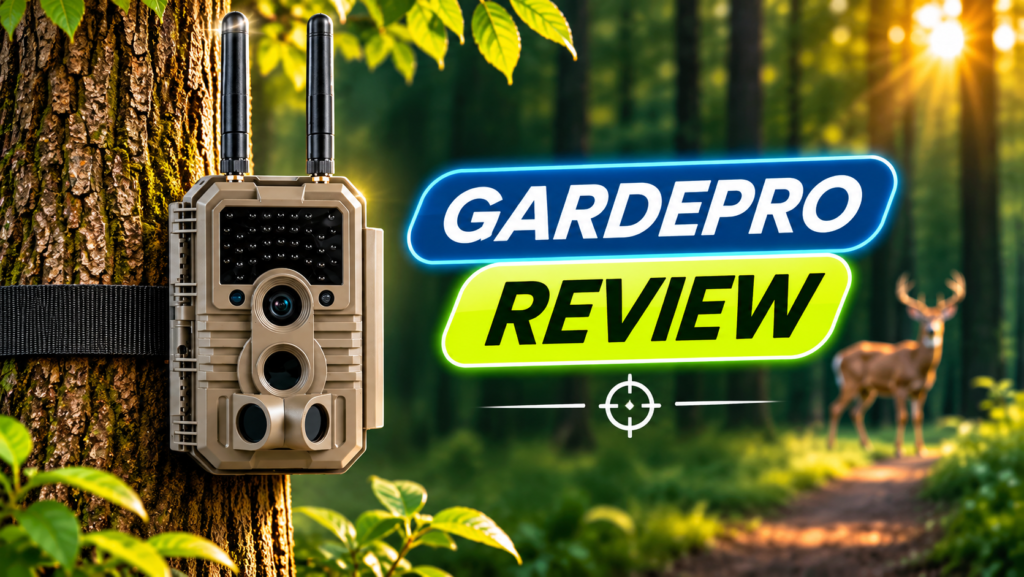
GardePro Trail Camera Review: Which Models Are Worth Buying?
Disclosure: this article contains affiliate links. If you buy through them, we may earn a commission at no extra cost to you. Prices were checked on GardePro’s US store in November 2026 and change frequently.
GardePro has grown from a budget Amazon trail camera brand into one of the bigger names in the category, with SD-card, Wi-Fi, cellular and long-range wireless cameras. That range is useful, but it also makes “is GardePro good?” hard to answer. The honest answer is that some models are excellent for the money and one has drawn a genuinely negative review.
This review pulls together independent lab testing, published hands-on reviews and owner feedback. The aim is to show which GardePro cameras are worth buying, what each one is really good at, and where the brand falls short.
GardePro at a Glance
| Camera types | Non-cellular (SD), Wi-Fi, home Wi-Fi, long-range wireless (Link), cellular 4G LTE, plus a thermal monocular |
| Price range (cameras) | About $60 to $225+ depending on model, pack size and promotion |
| Data plans (cellular) | $7 to $15 / month for the first camera, cheaper yearly; first month free |
| Warranty | 2 years when bought from GardePro’s own store |
| Returns and shipping | 30-day money-back guarantee; free shipping over $50 |
| Customer rating | 4.5 / 5 from 2,179 reviews on the store’s Loox review page |
| Discount | 15% off with code HELLO15 |
Understanding the GardePro Lineup
The model names are confusing, so start with this map. The letter usually tells you the family, and the family tells you how photos reach you.
Pick the family first, based on where the camera will live, and only then compare models inside it. A great cellular camera is a waste of money on a backyard feeder, and a great Wi-Fi camera is useless on land 50 miles away.
Non-Cellular Cameras: GardePro’s Strongest Category
GardePro’s SD-card cameras are where the brand earned its reputation, and the independent data supports it. TrailCamPro, which runs standardized lab and field tests, scored the GardePro T5CF Pro as follows:
The details behind those numbers are what matter in the field:
- Trigger speed: 0.5 seconds for photos with a 2-second recovery, and 0.86 seconds for video. That is quick enough to catch deer walking a trail.
- Detection: about 100 ft, which is long for a non-cellular camera.
- Battery: TrailCamPro estimates around 27.5 months of photo use on Energizer Ultimate Lithium AAs at 35 day and 35 night photos a day. That is exceptional.
- Close focus: it can focus on subjects as close as about 20 cm, useful for scrapes, feeders and small animals.
- Downsides: TrailCamPro flagged awkward file naming, subfolders capped at 1,000 photos, and the need to view photos through the Files app on iPhones.
One note on megapixels: GardePro, like most brands, advertises interpolated resolution. TrailCamPro lists the T5CF Pro’s 48MP as interpolated. Do not choose between trail cameras on megapixels. Trigger speed, detection range and night image quality matter far more.
On GardePro’s own store, the current SD-card lineup includes the A3S from $71.99 and the A60 from $99.99. The A60 uses a Sony STARVIS sensor and records 4K video, which is the upgrade to look for if night clarity matters most.
Wi-Fi Cameras: Good Value, Shorter Range Than Advertised
The E8 2.0 family is GardePro’s best-selling Wi-Fi line. The headline specs are strong for a camera that typically sells for $69 to $89: 64MP photos (interpolated), 4K video, a 0.1-second trigger, three PIR sensors covering a 120-degree detection zone, and 940nm no-glow infrared. Smart Home Explorer’s roundup of expert reviews gives it 7.6 out of 10 on average, with Outdoor Empire at 7.5 and TrailCam.org at 7.8. TrailCam.org said it “delivers image quality that rivals cameras costing twice as much.”
The thing to understand is how the Wi-Fi works. Standard E8 models create a direct connection to your phone. You walk within range, open the app, and download photos without touching the camera. They do not send photos to you while you are away. The rated range is 165 ft, but at least one owner on GardePro’s store said he needed to be within about 85 to 100 ft from the house to view images. Plan for less than the rated figure.
If you want alerts while away, look at the E8 3.0 Pro 4K Home Wi-Fi. It joins your home network and sends motion alerts, cloud images and HD photo requests over your own internet, with no monthly fee. The trade-off is that it must sit within reach of your router.
Owner feedback is mostly positive about image quality and setup. One owner reported that an app update stopped him viewing the screen of his E9P on an iPhone, which is a reminder that app-dependent cameras are only as good as their software.
Link 1.0: The Most Interesting Thing GardePro Makes
The Link 1.0 is GardePro’s answer to the monthly-fee problem, and it is the product most worth paying attention to in 2026.
How it works: R3 Pro cameras send images over a private long-range radio link to a hub. The hub plugs into your router with an Ethernet cable and passes everything to the app. GardePro rates it at up to 3,000 ft in open, line-of-sight conditions and about 1,600 ft in typical use, with up to 16 cameras on one hub.
What changed in 2026: from mid-May 2026, GardePro made the Plus Plan free for Link 1.0. That covers Live View, HD photo and video requests, preview uploads, 60-day cloud storage, notifications and camera sharing. Existing subscribers were moved over automatically and refunded the unused time.
Specs worth knowing: 4K video, a 7,800mAh rechargeable battery, support for the SP300 and SP1000 solar panels, and a free 64GB industrial-grade SD card in the box. At the time of writing, bundles were on sale from $224.99, down from $299.99.
Real-world range: the most useful owner report we found came from a buyer who said the system held reliable connections at 1,145 to 1,450 ft through woods. That is close to the “typical” rating and well short of the 3,000 ft headline. GardePro itself notes that walls and trees reduce range.
Limitations: it only works where you have home internet to plug the hub into. Email alerts are basic: off by default, photos only, and batched every five minutes. Photos arrive as previews and you request HD versions, while the originals stay on the SD card.
If your cameras will be on your own property within a few hundred yards of the house, the Link 1.0 is the GardePro product we would look at first. Our guide to trail cameras with no monthly fee compares it with the other subscription-free options.
Cellular Cameras: X66 Pro, X66 3.0 and X60P Live Max
GardePro’s cellular range is aggressive on price. At the time of writing, the X66 Pro was listed at $59.99 (regular $89.99), with a promotional X66 Pro 2-pack at $89.99. The newer X66 3.0 Pro 4K AI was $119.99 (regular $129.99), and the X60P Live Max was $89.99 with a free solar panel. Several pack variants showed as sold out, so availability changes week to week.
Key X66 3.0 Pro specs from GardePro’s product page:
- 64MP photos, 4K video, 0.1-second trigger, three PIR sensors
- On-camera AI that tags animals, people and vehicles, with no separate AI subscription
- Built-in 7,800mAh battery, rated at about two months under typical use with real-time upload on
- 940nm no-glow IR with about 100 ft of night range, built-in GPS, IP67 weatherproofing
The X66 Pro uses a multi-IMSI SIM that picks the strongest of AT&T, Verizon and T-Mobile in North America. That is a real advantage over single-carrier cameras if your land sits on the edge of coverage.
The negative review you should know about
Not every review has been positive. The Gadgeteer tested the X66 Pro in a Los Angeles backyard and came away disappointed. The camera rarely captured the reviewer’s 44-lb dog, which was outside most of the day, mostly missed small animals, and placed itself about 20 ft from its real location on GPS. The reviewer’s verdict was that it “might do the trick” for large game, but for small game “it’s a long shot.”
Two things put that in context. First, a backyard with small animals moving close and fast is a hard test for any PIR-triggered cellular camera, and these cameras are tuned for deer-sized animals at trail distances. Second, hunters testing the same model on trails have been far more positive; one field test featured on GardePro’s own blog is titled “This Camera is a WINNER!” (bear in mind the brand chose to feature it). Still, if your goal is catching raccoons, cats or birds near the house, a cellular camera is the wrong tool. A home Wi-Fi camera or an SD camera with close focus will serve you better.
What GardePro Data Plans Cost
| Plan | Allowance | First camera | Each extra camera |
|---|---|---|---|
| Basic | 500 photos / month | $7 / mo or $67.20 / yr | $5 / mo or $48 / yr |
| Standard | 1,500 photos / month | $10 / mo or $96 / yr | $7 / mo or $67.20 / yr |
| Premium | Unlimited photos | $15 / mo or $144 / yr | $11 / mo or $96 / yr |
A few details matter more than the headline prices. All cameras on one plan share a single data balance. The first plan on every account is free for a month. Yearly plans include bonus live-stream minutes and HD photo requests, while monthly plans only include a one-time 10-minute live stream. Live streaming only works on Live-series cameras such as the X66 family, and GardePro itself warns that it drains the battery quickly.
What Owners Praise and Complain About
GardePro’s store shows an average of 4.5 out of 5 from 2,179 reviews. Store reviews lean positive on any brand’s own site, so here are the recurring themes, both good and bad.
Common praise:
- Sharp daytime and night video for the price
- Solar panels that keep batteries topped up
- No cellular fees on Wi-Fi and Link systems
- Easy setup through the app
- Fast customer service, including quick replacement parts
Common complaints:
- Wi-Fi range shorter than the box suggests
- AA batteries on some models, such as the A5, instead of a built-in rechargeable pack
- Mounting accessories that need buying separately for some models
- Occasional app issues after updates
That pattern fits what we would expect from a value-focused brand. The cameras themselves are generally well regarded, and most frustrations come from range expectations and accessories.
Which GardePro Camera Should You Buy?
| If you want… | Buy | Why |
|---|---|---|
| Best value scouting camera | A60 or A3S | Proven SD-camera performance, huge battery life, no fees |
| Check photos from the truck or stand | E8 2.0 Pro | Fast trigger, strong image quality, direct Wi-Fi |
| Backyard or driveway alerts | E8 3.0 Pro 4K Home Wi-Fi | Remote alerts over your own internet, no plan |
| Several cameras on acreage near home | Link 1.0 | Live view and remote photos with zero monthly cost |
| Remote hunting land | X66 3.0 Pro | Multi-carrier LTE, on-camera AI, solar-ready |
Not sure whether you need cellular at all? Our cellular vs Wi-Fi trail camera comparison breaks down cost, range and battery for each approach.
How to Buy GardePro for Less
Buying direct from GardePro gets you the 2-year shop-exclusive warranty, which you do not get through third-party sellers, plus the 30-day money-back guarantee and free shipping over $50.
- Open the GardePro store with the link below and choose your model.
- Check bundles. Solar panels and SD cards are often cheaper as part of a bundle than added later.
- Enter HELLO15 at checkout to take 15% off. On items already heavily discounted for Black Friday, compare the total with and without the code, since some promotions may not combine.
- For cellular cameras, start on the free first month and watch your photo volume before choosing a plan.
Shop GardePro — 15% off with code HELLO15
Sources: TrailCamPro, GardePro T5CF Pro review; The Gadgeteer, GardePro X66 Pro cellular trail camera review; Smart Home Explorer, GardePro E8 2.0 overview (citing Outdoor Empire and TrailCam.org); GardePro product pages, data plans page and Link Plus Plan announcement; GardePro customer reviews on Loox.